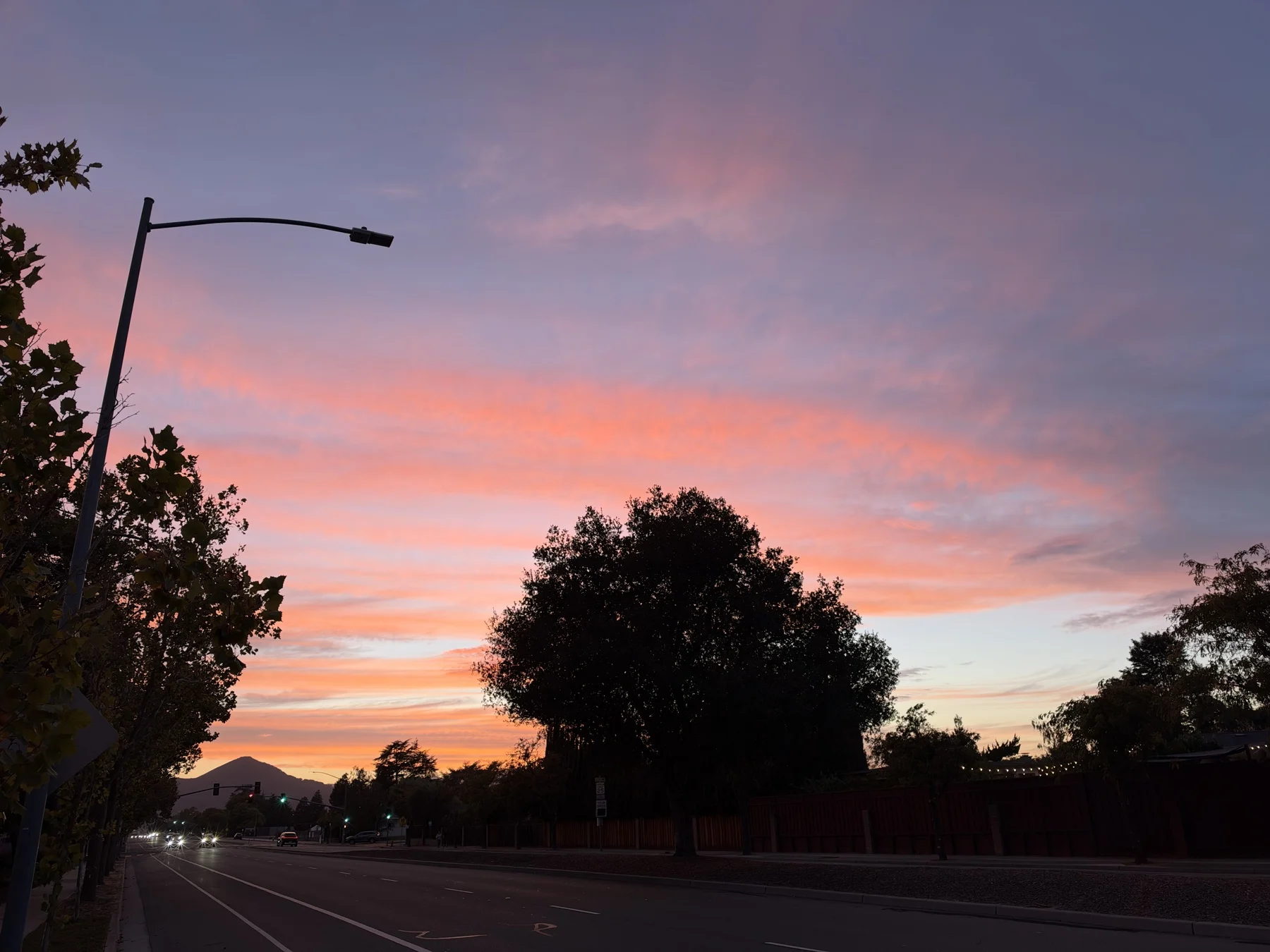
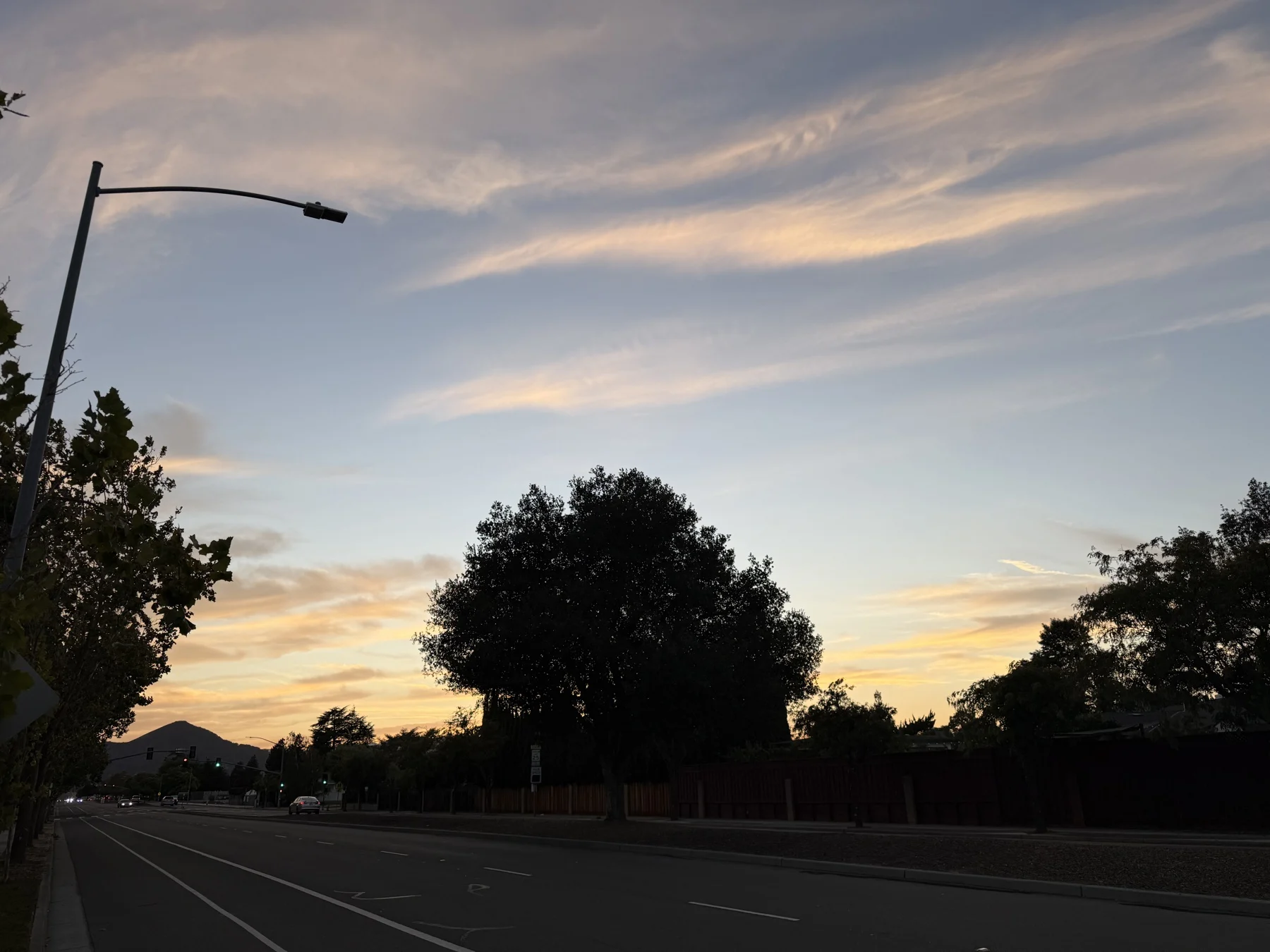
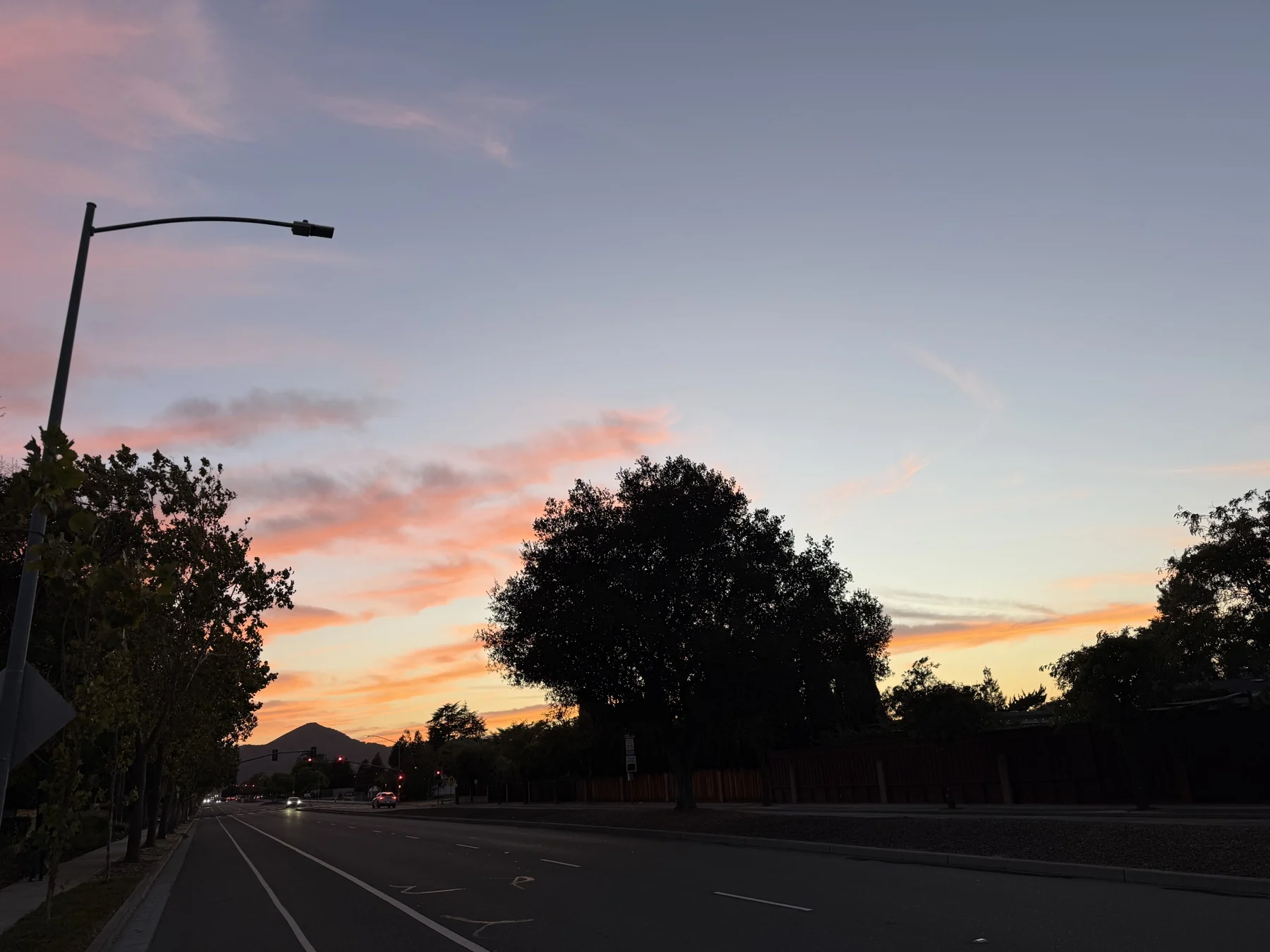
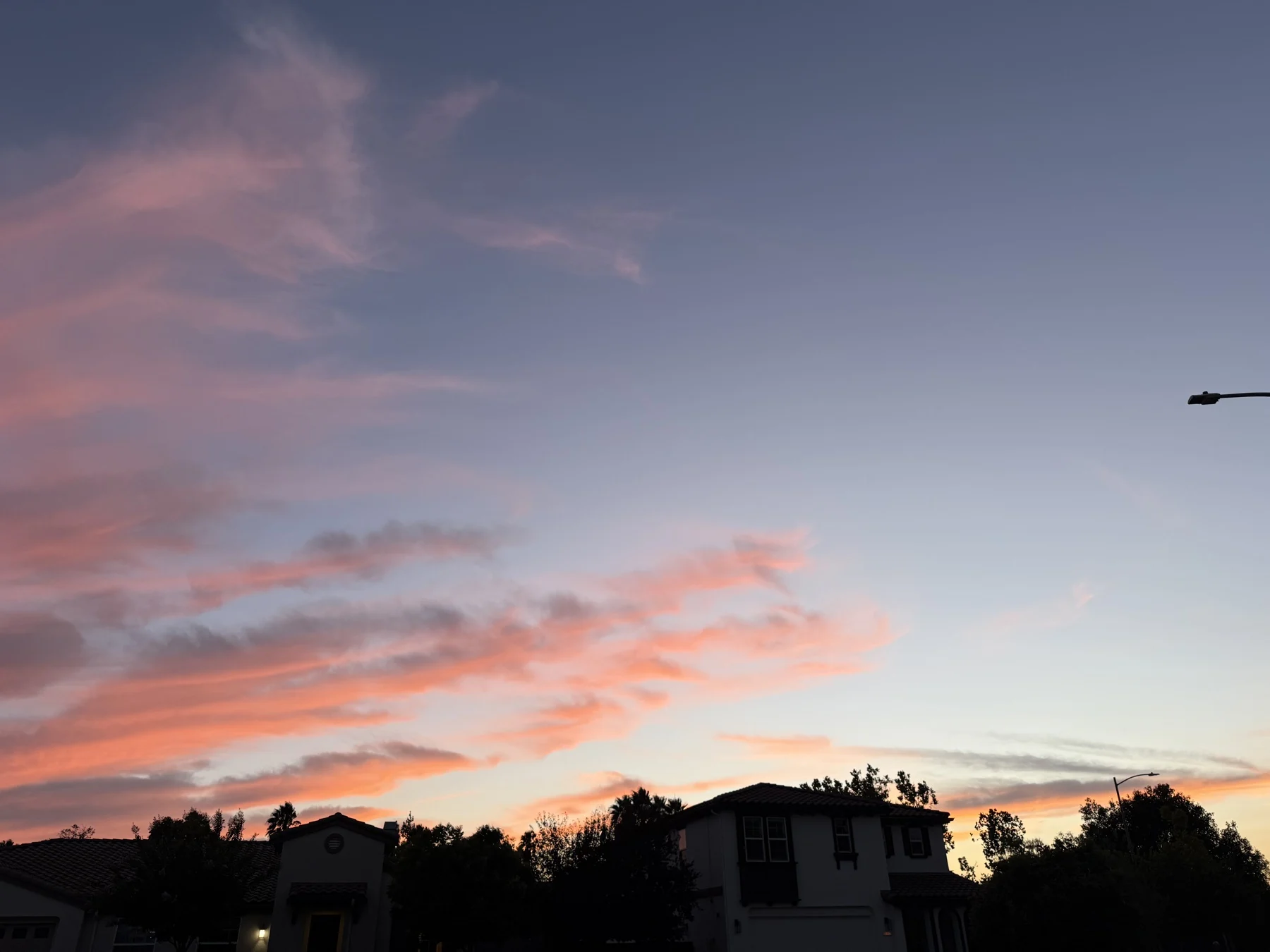
Two lessons from watching Morgan Hill’s evening sky: conditions along the coast around Half Moon Bay can shape the sunset here, and the best color often arrives after the sun drops below the horizon.
ONGOING RESEARCH Observations collected. Forecast validation next.
OCT 02, 2026 6:56 PM PDT7.5 / 10PERSONAL RATING
09documented evenings
15original photographs
03satellite products
FIELD RECORD Sep 08 – Oct 02, 2026
01 / TWO LOCAL DISCOVERIES
Look toward the coast. Stay after sunset.
The surprising part of this study is how far away—and how late—the ingredients of a good Morgan Hill sunset can be.
THE HALF MOON BAY CONNECTION
The weather over there can change the color here.
One of the project’s most interesting findings is the importance of the coastal cloud field around Half Moon Bay. Looking only at the weather in Morgan Hill leaves out part of the sunset.
Our working explanation is the path of the light: distant clouds can weaken or block the low-angle sunlight that would otherwise illuminate elevated clouds visible from Morgan Hill. Openings along that path can let the color come through.
COASTAL SKIESHalf Moon Bay region→LIGHT PATHCloud height + openings→MORGAN HILLClouds catching color
The exact coastal sector shifts with the season and the sun’s direction. Low coastal fog can lie below the relevant light path, so “foggy in Half Moon Bay” alone does not settle the forecast. Height and location matter.
THE AFTER-SUNSET WINDOW
The sun goes down. The color can still be building.
A second lesson from our observations: Morgan Hill’s best color often comes after the sun is below the horizon. Sunset time is the beginning of a viewing window worth staying for.
We can be in shadow at ground level while elevated clouds still catch sunlight. Those clouds can glow pink and orange against the darkening sky. Several strong moments in our collection were photographed about nine to ten minutes after calculated sunset.
+9.2 minSEP 20 · 6.5/10 evening
+9.9 minSEP 26 · 6.5/10 evening
+8.9 minOCT 02 · 7.5/10 evening
For now, stay through the next 15 minutes and pay particular attention around +10. These photos support a promising viewing window; a consistent sequence on more evenings will help locate the actual peak.
Nine evenings, from a small horizon glow to broad pink cloud layers. Ratings reflect one observer’s experience; they are observations, not model predictions.
SELECT PHOTO TO ENLARGE
OCTOBER 2, 2026
Color across the evening sky.
7.5/ 10
Photo dates and times come from the original files. Multiple photos from one evening remain one event. September 9’s 4/10 describes an early, pre-sunset photo; it does not establish the evening’s peak.
03 / FROM PHOTO TO SATELLITE
A repeatable way to read the sky.
The working tool connects each observation to a matching set of NOAA satellite files. That gives us a consistent foundation for testing the sunset model.
01
Keep the original observation.
Read capture time and location from the original phone photo. Record a personal rating and distinguish a single frame from the best photographed moment of an evening.
02
Choose the last complete scan.
For the requested time minus any lead time, find the most recent scan that has all three products. Match the satellite, scan mode, start, and end times. Preserve NOAA filenames and a record of every download.
03
Look toward the setting sun.
Prepare samples along a 200 km corridor and a ±10° cone, centered on the calculated solar direction. This connects the view from Morgan Hill to distant cloud layers and openings toward the coast; the direction follows the sun rather than a fixed line to Half Moon Bay.
04
Compare with what actually happened.
Carry quality flags into the analysis. Missing or unreliable data must not become “clear sky.” Compare predictions with independent evenings and preserve misses as well as successes.
ACHA2KMC
Cloud-top height
How high is the top of the cloud?
CCLC
Cloud layers
Where is cloud cover distributed vertically?
CODC
Optical depth
How optically thick is the cloud?
Sampling details and research boundaries
The current preparation samples every 10 km from 0–200 km and every 2° across the ±10° cone: 21 centerline points and 231 cone points per photo. Each product is sampled on its native grid. The 2° spacing is a documented preparation choice.
Sunset times use Astral with a level horizon and zero observer elevation. Local hills can change when the sun actually disappears. The corridor is an analysis region, not a complete model of the sunlight’s atmospheric path.
The original scoring formula has not been fully reproduced in this workflow. This page reports observations and completed data preparation, not newly validated model scores.
The practical lesson for watching a Morgan Hill sunset is to stay after the sun disappears. September 13 shows why we photograph the whole transition: one frame near sunset, then two more about ten minutes afterward.
NEAR SUNSET7:16 PM · −0.4 minTHE AFTERGLOW7:26 PM · +9.7 minANOTHER MOMENT7:27 PM · +10.4 min
The current observing routine: sunset → +5 → +10 → +15 minutes. Ten minutes after sunset is a useful test point, not an established universal best time. This evening’s overall rating was 5/10.
05 / HOW THE STUDY EVOLVED
The misses shaped the method.
The project began with photographs and sunset estimates. The useful questions came from evenings that did not match expectations.
START WITH THE SCENE
“Some clouds” is not enough.
Early estimates exposed two different problems: promising clouds can fade before sunset, while distant elevated clouds can make a locally quiet sky more interesting. The method needs both location and change over time.
CHECK THE GEOMETRY
Height changes the story.
The Half Moon Bay connection made the distant coastal sky part of the investigation. A low marine layer and elevated clouds play different roles, so the research began examining cloud height, Earth’s curvature, and openings along the light path.
MAKE EACH CASE REPEATABLE
Keep time, data, and ratings together.
Original photos preserve the observation time. Automated retrieval now pairs them with complete satellite scans, while confirmed ratings remain separate from provisional estimates.
These are lessons and hypotheses from the project’s research notes. Nine documented evenings are a small, personally selected sample; they do not establish forecast accuracy or the frequency of good sunsets in Morgan Hill.
06 / THE NEXT HORIZON
Know when to step outside.
The ambition is simple: a useful heads-up an hour or two before sunset, with an expected quality and a viewing window. Getting there starts with testing the forecast.
Freeze a scoring method. Make predictions using only data available 60 and 120 minutes ahead, then compare with photographs collected on a consistent schedule—including uneventful skies.
FIRST APP DRAFT
A companion on your phone.
Plan a viewing window and keep a private photo journal on your device. Try Sunset Predictor ↗. Server uploads, quality forecasts, and notifications are the next stages.
Phone uploads, notifications, messaging integration, and worldwide predictions are ideas for a later phase. The current site is a field journal.